Plants, giants, and other worlds

A few weeks ago, I gave a fun interview to Amy Wilkinson at MTV News about the “science” behind Jack the Giant Slayer, a re-telling of Jack and the Beanstalk. Jack the Giant Slayer movie posterThe first thing that came up was how we tend to forget that plants are even alive. I had planned to bring this up at some point in our conversation, but Amy set it up beautifully by asking, “So is it even possible for a plant to actually come alive (like in the film)?” Of course I don’t fault her at all for stating it this way, and when I pointed out that plants are already, in fact, alive, she laughed at herself. But we both knew what she meant, in part because we really do tend to think of plants as part of the scenery — inert, inanimate, unchanging. In reality, none of those are true, but the things they do, they do on a frequency that we don’t share, leaving so much of their activity functionally invisible to us. This invisibility is part of what makes it so startling and fun when a plant is cast as a character in a story like Jack and the Whatever.

As if it were not enough that plants do their things too slowly to notice, we have also managed to exile them from our day-to-day lives almost completely. Unless you are one of the 3.4 in 1000 Americans claiming farming as your occupation, you likely don’t have any need to think about plants actually growing. Sure, many people enjoy gardening or horticulture as a hobby, but I suspect most of them see plants through the lens of scenery and decoration, not as the living, active organisms they are. After all, if you can buy it in the Wal-Mart parking lot, how alive could it be?

Some plants, of course, do grow at a rate that approaches our own perception. World record-breaking pumpkins, for instance, can add 50 lbs of mass per day at the peak of their growth — you could nearly hear the water flowing into the gourd, I suspect. Certain varieties of clumping bamboo can grow about 3 ft per day — just shy of 1 mm per minute, so you’d have to watch closely, but you may just notice it. Certainly if you checked, enjoyed a cold beverage, and checked again, you’d be able to tell.

General Sherman RedwoodThese plants all pale in comparison to the mighty redwoods, Sequoiadendron giganteum. These gigantic organisms have literally billions of leaves and gain several tons per year in mass, almost all of which is added from thin air via photosynthesis. These giants actually speed up their growth rate as they age, something I’m sure many companies would love to replicate if they could. Their sheer size aside, the redwoods are an apt example here for another reason. Like the beanstalk in the folk tale, scientists have found an utterly foreign and fascinating world 250 ft above the ground, in their crowns. While it may not be filled with killer giants and gold coins, I’d happily trade an old cow for a chance to visit such a world and have a look around.
Venture Capital’s Massive, Terrible Idea For The Future Of College [link]

Maria Bustillos, in a long piece in The Awl, brings some great clarity and perspective to the hype and bluster of the MOOC. This quote, from Aaron Bady, who recently touched off a storm with his piece on Inside Higher Ed, captures a bit of the flavor well:

The thing is, when you frame this as, “what does this give them for the rest of their lives?” one never really knows, and I think that’s the point; there is something, but it’s something we’re all discovering together. When we reduce education to job training; when we reduce it to, “we need X skills, so let’s do whatever causes X skill to come out,” you really close down all the possibilities.


Presentation on teaching technology

Last week I had the opportunity to share with the OWU Board of Trustees some of the ways I’m using technology to enhance my teaching. I shared about my experiences trying to ‘flip’ my intro cell biology class last semester. Below is a rough outline of my 10-min talk, and here are my slides, which should be viewable in any modern browser1.watch full Louis C.K. 2017 2017 movie online

Trying a Flip

What’s the idea?

  • expose students to concepts through self-guided study prior to class
  • spend class time helping students apply concepts to solve problems
  • technology is an enabler for this kind of teaching

Why flip?

  • better use of class time than lecture
  • encourages students to build more critical thinking, application skills
  • critical thinking and problem-solving skills are a major point of emphasis in recent reports on the state of improving undergraduate science education
  • research evidence that it’s better for learning than lecture

How did I do it?

  • switched to new, more modular, online textbook, required reading in advance
  • created in-class experiences allowing students to apply concepts
  • created website that provided scaffolding for students
  • student groups kept an online notebook, shared with me, for feedback and input
  • used online clicker questions through polleverywhere.com to register student understanding

How did it go?

  • classroom space design was a real inhibitor to exploration and discussion
  • holding classes like this in a space designed for active learning would be amazing
  • students are very reliant on lecture for information transmission
  • designing in-class experiences is difficult, time-consuming

  1. I made the presentation with reveal.js, a framework for making presentations with HTML. The whole presentation lives in a simple text file. Use the space bar or arrow keys to navigate; press ESC to pick a specific slide. What can I say, I like to experiment! 

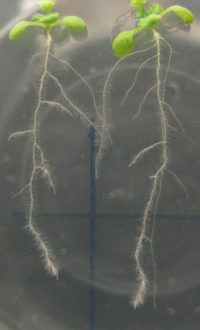
Studying gravitropism in lateral roots

Arabidopsis seedlings showing lateral rootsQuick, what’s the first thing you think of when you think about plants? A tree? Leaves? A flower? Chances are slim that you thought first of a root, yet roots make up nearly half of the typical plant’s body. They are the hidden side of the plant, feeling their way in the dark, around stones and through soil, in search of the water and minerals needed for survival. They sense things like moisture gradients, solid objects like rocks and pebbles, and can tell up from down, using these cues in ways that remain largely unknown to guide their growth. Considering that we humans are completely dependent upon our photosynthetic, green cousins for the food we eat and the air we breathe, and considering the vulnerability of plants to drought, we would do well to learn more about how roots do what they do.

Despite making up the vast majority of the root system, how lateral roots choose their path remains uncharted territory. For example, lateral roots are content to grow sideways for long periods, a situation that is anathema to primary roots, which react swiftly with a course correction when they find themselves growing sideways. It isn’t like lateral roots are unable, however, to mount such a course correction. When displaced from their route, they will return to it, whatever it was. But when the course was not-quite-vertical, how do they know where to go? Are they using the same cellular tools as the primary root to detect gravity? Are the same circuits that activate curvature in the primary root activated in lateral roots? Given their role in nutrient uptake, do lateral roots change their course when nutrient conditions change? In our most recent paper, we set out to address some of these questions about lateral root growth. Over the coming weeks, I’ll be posting more on how we carried out our experiments and what we found out.

AJB Special Issue on Tropisms

I am honored to have a paper in this month’s American Journal of Botany, a special issue focused on plant tropisms. Below is a collection of links highlighting some of the work:

Scientists join forces to bring plant movement to light:

Elementary school students often learn that plants grow toward the light. This seems straightforward, but in reality, the genes and pathways that allow plants to grow and move in response to their environment are not fully understood. Leading plant scientists explore one of the most fundamental processes in plant biology—plant movement in response to light, water, and gravity—in a January Special Issue of the American Journal of Botany.

Low Phosphate Alters Lateral Root Setpoint Angle and Gravitropism (our paper):

Lateral root orientation and gravitropism are affected by Pi status and may provide an important additional parameter for describing root responses to low Pi. The data also support the conclusion that gravitropic setpoint angle reacts to nutrient status and is under dynamic regulation.

I’ll post again on the work that went into our paper, including a breakdown of the inputs of time and talent that made this work possible. In short though, three awesome students worked many hours in the lab over the course of four years to produce these insights.

As the MOOC turns

Below is a collection of links to recent articles and essays on MOOCs. Think of this as a primer for those of us who have been too busy, you know, actually teaching, to keep up with the latest developments.

The Crisis in Higher Education — Nicholas Carr, MIT Technology Review — A fairly balanced review of what MOOCs are, including a concise version of the Sebastian Thrun-Coursera creation myth. The comparison of MOOCs to the creation of correspondence courses in the early part of the 20th century seems apt.

Napster, Udacity, and the Academy — Clay Shirky — The author, a disruptologist, surveys the higher education landscape and finds it ripe for, you guessed it, disruption. Likening courses to MP3s, and by extension, universities to record labels, he argues that it is only a matter of time before the reckoning happens.

Questioning Clay Shirky — Aaron Bady, Inside Higher Ed — Both a rhetorical and substantive critique of Shirky’s disruption argument, Bady points out the steep decline in states’ funding for higher education over the past 2 decades as a key factor in driving unmet educational need, opening the door for MOOCs and for-profit ‘universities.’

Providers of Free MOOC’s Now Charge Employers for Access to Student Data — Jeffrey Young, The Chronicle of Higher Education — This explains why so many venture capitalists are lining up to ‘invest in education.’ One way to monetize students is to sell access to them to the highest bidder. It’s Google AdWords for people!The Boss Baby movie download

The Great Decoupling of the American Economy — Andrew McAfee — While not directly addressing MOOCs, I was struck by the applicability of the idea of reducing the need for ‘labor’ (if you can call faculty that) with capital investment, which is essentially what MOOCs do. Decoupling scholarly pursuit from instruction, which is one logical outcome of the MOOC, would undoubtedly lead to a loss of academic scholarship. But increasing economic efficiency like this is supposed to lead to more free time to pursue one’s interests, which is the original definition of schola; this seems terribly ironic.Blackhat 2015 movie