All crops are genetically modified

A few days ago Kevin Folta, a colleague whose main research focuses on strawberry genetics and crop improvement, tweeted a link to an interview he did with HuffPost Science. The video sums up a lot of the same ideas I try to communicate in my classes about genetically-modified foods, both their risks and their benefits. The post on HuffPo Science has received almost 2000 comments as of this writing, so it clearly struck a nerve.

One of the points he makes is that humans have been doing genetic modification for tens of thousands of years. All of our crop plants are the result of mutation, selection, natural hybridization, and in some cases, deliberate hybridization. There is no such thing as ‘natural corn’ — it is the product of human civilization and could not survive without us. And when genetic modification happens naturally or through traditional plant breeding, whole genomes are scrambled. Modern genetic engineering allows targeted access to a single gene at a time, either by inserting a new, well-studied gene into a plant, or regulating the expression of an existing gene. But for some reason, the backlash against the modern, targeted approach is far beyond that of other techniques.

Sometimes the backlash is motivated by a disdain for the large companies that control so much of our food supply (and our politicians). But there is also a genuine fear that scientists are messing around with things they don’t understand and it will kill us all, or at least seriously mess up our lives and environments. I am all in favor of testing new crops for human and environmental safety. I believe crop biotechnology deserves neither a free pass nor impossible regulations. To hold transgenic crops to a standard that they be proven to do no harm to an ecosystem (an effectively impossible claim to uphold) when no other crop has ever been held to such a standard is hypocritical.

Apple opens iTunes U registration

Yesterday, Apple made it possible for anyone to create an iTunes U course simply by activating their Apple ID in the iTunes U Course Manager. Previously, an instructor had to have their Apple ID activated by a school or college and be associated with that school’s iTunes U account in order to create courses. For a seemingly small change, this carries huge potential for increasing the availability and usage of the iTunes U platform, which I’m sure was Apple’s intention.

What Apple has done is to move the control over registration from the institutional level into the hands of the individual. I suspect one of the major frustrations Apple heard about iTunes U was that a school had to have an institutional iTunes U account in order for faculty to sign up and create courses. Now that anybody with an Apple ID can register, this removes that barrier. I would think that, at any time, an instructor could also have their institution associate their Apple ID with their school, but this is no longer a bottleneck (or gatekeeper) in the process. And it certainly was a bottleneck for me.

A couple weeks ago, I decided I wanted to use iTunes U as another way to package my course materials for the fall semester, so I searched through my email archives to find the login details sent last semester by our Info Services staff. These credentials opened iTunes and took me to the private OWU page, but didn’t seem to give any obvious way to create or manage a course. After digging through the help site for a while, I realized that I needed access to the iTunes U Course Manager, which was a web-based site, not one within the iTunes store. I contacted our Info Services director, and he followed up with Apple about how to add faculty users to our account. We’re still waiting to hear back from them.

Meanwhile, yesterday’s change means I no longer need to wait to hear back from them to start creating a course in iTunes U. Their reply matters only if I want to become what Apple calls an *affiliated instructor*. This allows my institution to add my courses to the school’s iTunes U page and grants me unlimited storage rather than the “limited” 20 GB of an unaffiliated user. Unless you’re planning to include video lectures (I’m not), I can’t imagine bumping up against such a generous limit.

Not only does this change lower or remove the institutional barrier to entry for instructors, it grants creative access to literally everyone with an Apple ID. I suspect this will expand the range of uses of iTunes U dramatically. For instance, a homeschooling consortium could create and share courses among its members easily. Small businesses could create courses that train new employees. Salesmen could package their brochures and background materials on products for their clients. These are all examples of creators that were previously excluded from creating materials due to their lack of affiliation with an institution who can now, with a few clicks, publish on this platform. All with a tiny change in account registration policy.

Making 3D Collada files for iBooks Author from PDB files

TIR1 complex structure involved in auxin signaling
This is a ribbon diagram of the TIR1 complex, a collection of proteins that acts as an auxin receptor.

While messing around with iBooks Author, working on graphics and other media supplements for my book project, I noticed the ‘3D’ type of widget. I would love to be able to include a few structures of proteins in my project, so I started reading up on what kinds of files it supports. In short, it takes only 3D Collada files (short for collaborative design activity) and would allow the viewer to manipulate the structure on the iPad. Sounds great, but how do I make a 3D Collada (.dae) file?

The standard for storing 3D data for biomolecules is the PDB file, short for Protein Data Bank, and available for download from sites like the Research Collaboratory for Structural Bioinformatics (RCSB) PDB. Pretty much every protein that has been crystallized has had its coordinates deposited as a PDB file there. The great thing about PDB files is that they are not static images, they are a set of instructions for drawing a structure, and therefore can be interactively manipulated if opened with the right software.

The problem is, iBooks Author is not the ‘right’ software – it does not read PDB files. But fancy 3D modeling software like Maya or Blender, both of which export 3D Collada files, do not have a clue how to open a PDB file. Oh bother. A little searching around, though, led me to an open source plug-in called the embedded Python Molecular Viewer, ePMV. This nifty software loads within the fancy 3D modeling environment and gives you access to those PDB files.

After installing the version of Blender from the ePMV site and enabling the plug-in, I could open PDB files and begin playing around with the many, many settings available for coloring, lighting, and displaying the structure. I have a lot to learn as far as using the software to customize all of these features, but at least I’ve successfully exported a Collada file and inserted it into my iBook project. Now that I have a way to use them, it’s time to think about which structures I want to include and where.

Science apps

The Mental Floss blog has an article on what I was talking about yesterday:

Scientists have started to use the abilities and prevalence of smartphones to their advantage, creating apps specifically for their studies and crowdsourcing observation and data collection. When almost everyone has an Internet connection, a camera, and a GPS unit right in their phone, almost anyone can gather, organize, and submit data to help move a study along. Here are 10 projects and apps that will turn you into a citizen scientist.

OK, so its focus is apps for phones, but it’s getting there. Many of these examples are doing things that rely on the assembly of technology to do something that couldn’t be done without it, or not as well.

Re-imagining my intro biology class – First steps

I spent the better part of the morning today beginning to re-imagine my intro biology class for the fall, even though I should probably be doing other things more related to research. I’m taking advantage of switching to a new textbook to revamp the whole class from the ground up. Here are my main objectives with the rewrite:

  • spend as little time as possible “covering” material in class
  • use class time to allow students to interact with concepts and apply ideas to real-world problems in small groups rather than transcribing lecture notes

My approach relies heavily on students having read the material before class, so I’m starting with the readings. The Principles site makes it relatively easy to customize the readings, including both the selection and order. It’s a little annoying that their metaphor is “customizing a book” and then “publishing” the custom text. I would like it better if it were easier to add, subtract, and move modules around more dynamically as I assign due dates and create assignments. But other than that, it doesn’t try to impose any additional structure on the course, which I like. I’ve complained before about the proliferation of buckets in the LMS (pages, content, files, documents, etc), and this site does not use such arbitrary categories.

The main thing I’m struggling with is predicting how much time I’ll need for each topic and set of objectives. It’s hard to get out of the mindset of, “How long will it take to walk through this topic from start to finish in front of the class” and instead think about questions, projects, and problems that would help the students apply and synthesize these concepts. I have to admit, at this point sticking with the tried-and-true lecture format sounds much easier, but I really want to try something new (and hopefully more effective).

Streaming The Autopsy of Jane Doe (2016) For [FREE] online

<p>The Autopsy of Jane Doe (2016) English Subtitles Full HD, Full Movie Online Streaming Free, Free Movies Streaming , Free Latest Films. </p>

<p align="center"><a href="https://shihadmovie.com/movie/397243/the-autopsy-of-jane-doe.html"><img width="342" src="https://image.tmdb.org/t/p/w1280//cEPR5dx1XMMvBtuzBIL4rR5xnh5.jpg" /></a></p><hr>

Quality : HD<br>
Title : The Autopsy of Jane Doe.<br>
Director : André Øvredal<br>
Release : December 21, 2016<br>
Language :  en.<br>
Runtime : 86 min<br>
Genre : Horror, Mystery.<br>

<strong>Plot</strong>
'The Autopsy of Jane Doe' is good film tell story about Father and son coroners who receive a mysterious homicide victim with no apparent cause of death. As they attempt to identify the beautiful young "Jane Doe," they discover increasingly bizarre clues that hold the key to her terrifying secrets. This film have genre Horror, Mystery and have 86 minutes runtime.

<strong>Cast</strong>
Olwen Catherine Kelly as Jane Doe, Parker Sawyers as Officer Cole, Ophelia Lovibond as Emma, Michael McElhatton as Sheriff Sheldon, Brian Cox as Tommy Tilden, Emile Hirsch as Austin Tilden.

<strong>Production</strong>
The Director of this movie is André Øvredal. The movie The Autopsy of Jane Doe is produced by Impostor Pictures, 42, IM Global and released in December 21, 2016.

<p align="center"><a rel="follow" href="https://shihadmovie.com/movie/397243/the-autopsy-of-jane-doe.html">Watch Full Movie The Autopsy of Jane Doe (2016)</a></p>

<p>I serve You with the best possible view of the facilities and procedures to follow step by step so that U (the visitor) will feel like a king. Download The Autopsy of Jane Doe, take a little time now to register for free and U can benefit later.</p>

<p>In addition, the movie The Autopsy of Jane Doe security issues and antivirus technology, You no longer have to worry about any set of data transfer security disturb your precious PC or laptop. Also, with a different file formats such as DVD, CD, iPod, HDD and Divx, now You can really forget about replusive video format that can not be played! So guys, now it’s time for U to sit back, relax, drinking a can of cola (cold drink) or some snacks to watch The Autopsy of Jane Doe online just take 86 min, and U will feel U like in the cinema room. just by sitting in front of your computer and sign in to our site to watch The Autopsy of Jane Doe online and You could see your favorite movie the other.

<p align="center"><a href="https://shihadmovie.com/movie/397243/the-autopsy-of-jane-doe.html" rel="follow"><img title="" src="http://i.imgsafe.org/167e074842.jpg" alt="" width="400" /></a></p>


<p>Incoming search term : <br><br>The Autopsy of Jane Doe Online Free Megashare<br>Watch The Autopsy of Jane Doe Online Free putlocker<br>Watch The Autopsy of Jane Doe Online UltraHD<br>The Autopsy of Jane Doe Free Online<br>Watch The Autopsy of Jane Doe  (2017)  Online Free<br>Watch The Autopsy of Jane Doe Online HDQ<br>The Autopsy of Jane Doe Episodes Online<br>The Autopsy of Jane Doe For Free online<br>Watch The Autopsy of Jane Doe Online Mediafire<br>The Autopsy of Jane Doe (2017)  English Full Episodes Download<br>Watch The Autopsy of Jane Doe (2017) Online Free megashare<br>The Autopsy of Jane Doe English Full Episodes<br>The Autopsy of Jane Doe English Episodes<br>Watch The Autopsy of Jane Doe Online Free megashare<br>Watch The Autopsy of Jane Doe Online Free Putlocker<br>The Autopsy of Jane Doe English Full Episodes Online Free Download<br>The Autopsy of Jane Doe (2017)  English Episodes<br>The Autopsy of Jane Doe (2017)  Episodes Online<br>The Autopsy of Jane Doe (2017)  English Episode<br>Watch The Autopsy of Jane Doe (2017)  Online Megashare<br>The Autopsy of Jane Doe (2017)  English Full Episodes Watch Online<br>The Autopsy of Jane Doe (2017)  For Free Online<br>Watch The Autopsy of Jane Doe Online Christiantimes<br>Watch The Autopsy of Jane Doe Online Instagram<br>The Autopsy of Jane Doe (2017)  Online Free Megashare<br>The Autopsy of Jane Doe (2017)  Watch Online<br>Watch The Autopsy of Jane Doe Online Allmyvideos<br>The Autopsy of Jane Doe Free Online<br>Watch The Autopsy of Jane Doe Online Viooz<br>Watch The Autopsy of Jane Doe Online Independent<br>The Autopsy of Jane Doe English Full Episodes Online Free Download<br>The Autopsy of Jane Doe (2016)  For Free Online<br>Watch The Autopsy of Jane Doe Online Collider<br>Watch The Autopsy of Jane Doe  (2016)  Online Viooz<br>The Autopsy of Jane Doe HD English Full Episodes Download<br>The Autopsy of Jane Doe (2016)  English Episodes<br>The Autopsy of Jane Doe For Free online<br>Watch The Autopsy of Jane Doe Online Indiewire<br>Watch The Autopsy of Jane Doe Online Instanmovie<br>The Autopsy of Jane Doe (2016)  English Full Episodes Free Download<br>UltraHD Watch Stream Online The Autopsy of Jane Doe<br>The Autopsy of Jane Doe English Full Episodes Download<br>Watch The Autopsy of Jane Doe (2016)  Online Megashare<br>The Autopsy of Jane Doe Free Download<br>The Autopsy of Jane Doe (2016)  English Full Episodes Online Free Download<br>Watch The Autopsy of Jane Doe (2016)  Online Putlocker<br>The Autopsy of Jane Doe English Full Episodes<br>Watch The Autopsy of Jane Doe Online Allmyvideos<br>Watch The Autopsy of Jane Doe  (2016)  Online Free Viooz<br>The Autopsy of Jane Doe Episodes Online<br>The Autopsy of Jane Doe HD Full Episodes Online<br>Watch The Autopsy of Jane Doe Online Cinemark<br>The Autopsy of Jane Doe English Episodes Free Watch Online<br>Watch The Autopsy of Jane Doe Online Megashare<br>The Autopsy of Jane Doe Watch Online<br>The Autopsy of Jane Doe English Episode<br>Watch The Autopsy of Jane Doe Online Megashare<br>Watch The Autopsy of Jane Doe Online VodlockerHd<br>The Autopsy of Jane Doe Episodes Online<br>Watch The Autopsy of Jane Doe Online HIGH quality definitons</p>

Journal impact factor losing impact

George Lozano, blogging about a recent study he published on journal impact facors:

Furthermore, we found that until 1990, of all papers, the proportion of top (i.e., most cited) papers published in the top (i.e., highest IF) journals had been increasing. So, the top journals were becoming the exclusive depositories of the most cited research. However, since 1991 the pattern has been the exact opposite. Among top papers, the proportion NOT published in top journals was decreasing, but now it is increasing. Hence, the best (i.e., most cited) work now comes from increasingly diverse sources, irrespective of the journals’ IFs.

To me, this is an indicator of the power of, first scholarly databases, then the internet, to make important work more discoverable. When I began graduate school, I remember doing literature work in the library and watching all the faculty come for their weekly journal check-in to “stay current” (or name-check themselves and their pals). How much more efficient and effective it is now to rely on things like saved database searches to keep us informed of important advances in our field. And database searches democratize by returning all related citations, not just those from so-called top-tier journals. This is a great step forward, I think.

Students becoming less dependent on physical books?

Inside Higher Ed has an update on electronic textbook adoption which is mostly uninteresting to me except for this bit:

Nevertheless, students’ allegiance to print appears to be eroding; among those who did not purchase a digital text, only 39 percent said they “prefer traditional print textbooks” — down from 50 percent two years ago and 59 percent three years ago.

Student habit and comfort level is one of the hardest things to change, and this survey suggests that college students are quickly dropping their insistence on a physical, paper book. If this is true, this will open up the field to all kinds of experimental approaches to textbooks. I’ll be finding out soon enough with my fall class how comfortable students are with a fairly radical electronic “book”.

Coverage of tomato discovery also tastes like cardboard

Yesterday saw a flurry of reports about a new article in Science on tomato flavor, or the lack thereof. Here are a few:

While it’s great to see such widespread coverage of a plant science discovery, as I read through each report I couldn’t help but notice the disconnect between the bold titles and the substance of each article.

Here is the science: the researchers found the molecular identity of a historical mutation in fruit development that plant breeders have selected for that makes the fruits more uniform in color and lighter green. The gene encodes a transcription factor that controls chloroplast development. When mutated, as in almost all cultivated tomatoes, it leads to fruits with fewer chloroplasts, which explains the lighter, more uniform coloration. It also leads to lower carbohydrate and pigment concentrations, which the researchers suggest could impact flavor.

The problem with the bold article titles is, the flavor of a tomato is much, much more complex than its sugar content. Tomatoes contain over 400 volatile compounds, each of which interacts with the others and nonvolatile compounds to produce the overall flavor profile. Understanding how each of those hundreds of molecules is formed and processed in the fruit throughout ripening is likely to yield better tasting tomatoes, and maybe having more total carbohydrates will be a part of that process. But the original article didn’t even begin to explore flavor, so why is that the take-home message of all the news pieces?

To me, the Science paper is extremely interesting, but not for the reasons highlighted in these articles. This is a case of classical breeding carrying out selection on a trait that seemed to improve the crop, at least from the standpoint of the grower, making it more consistent and easier to market. But now that we know what (in the molecular sense) they were selecting, we can see it was probably a poor tradeoff. This is yet another in a long line of links between classical breeding choices and molecular genetics, and this represents an excellent way to educate the public that all of our food is genetically modified! It all has DNA! Genes, even! I continue to be fascinated as we uncover the ancient — and recent — mutations that produced the foods we know, and I think it provides a great chance to inform and begin a dialog over the nature of farming, breeding, and genetics.

Google Chrome on iOS

Google Chrome shipped yesterday for iOS, and you may be wondering if it’s worth giving it a try even though it’s limited in significant ways due to Apple’s App Store policies. There are many reactions that bemoan this fact, pointing out that Chrome for iOS is not even as fast (at some limited functions) as Mobile Safari, and that it’s just a wrapper around Apple’s browser rendering engine. I decided to check it out because I’ve been using Chrome on my computer and want to see how well my bookmarks, open pages, and stored passwords sync.

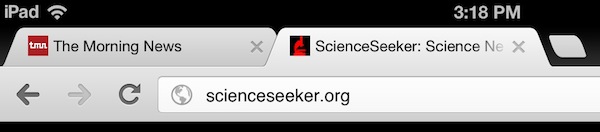
After using it heavily for a day now, I’ve really enjoyed several of its design features, one of which makes it feel even faster than Mobile Safari. Chrome for iOS employs the omnibox, just like in the desktop version, which saves time in and of itself. But I’ve noticed that it seems to pre-cache web pages when I start a search, such that if I choose the first site or word in the list, it loads the page almost instantly. This shows the advantage of the omnibox and, at the same time, indicates some behind-the-scenes work that Google has done to help Chrome feel faster than Mobile Safari. The other design touch I’ve noticed is that Chrome for iOS lets me close a tab that is not the currently-active tab (see image below). This has always annoyed me about Mobile Safari, not being able to ‘x-out’ of an inactive tab.

Tabs in Google Chrome for iOS
note the X even on the inactive tab

The biggest annoyance so far is with accessing bookmarks, as there is no ‘Bookmarks bar’ in Chrome for iOS. This means that I have to tap-tap-tap to get to a bookmark that is only one tap away in Mobile Safari. Then again, it’s not bad to have that vertical scroll space back that would be occupied by the Bookmarks bar. Anyway, I’ve been impressed so far.